
What is the role of packaging design, reverse logistics and business models in a reusable packaging system? How do consumer behaviour and policy frameworks shape outcomes? And under which key conditions do reusable packaging systems actually work at scale? The chapter brings these elements together and highlights key trade-offs and decision points.
Packaging plays a critical role in enabling contemporary food value chains. However, the overconsumption of single-use packaging has turned packaging waste into a major environmental concern. Reusable Packaging Systems (RPS) have emerged as a promising strategy to keep materials in circulation, preserve their value, and minimize waste generation.
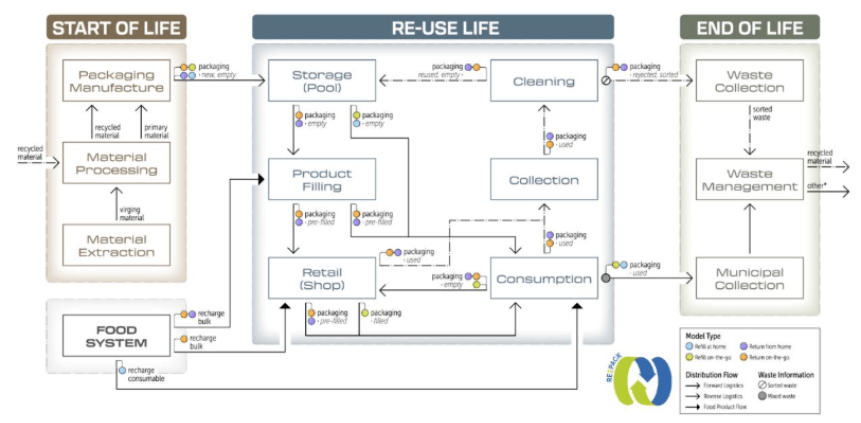
This chapter provides a state-of-the-art overview, analyzing the key factors, barriers, and opportunities influencing RPS implementation and performance. Drawing on multiple assessment approaches, it examines diverse food system applications to illustrate how technological, organizational, behavioral, and policy factors shape environmental and economic outcomes. By linking perspectives from industrial design, industrial ecology, consumer behavior, business, and innovation studies, the chapter offers a multidisciplinary understanding of the conditions enabling RPS success. It concludes by situating these insights within a systems-thinking perspective that connects technological change with broader systemic transformation.
More information
Read the chapter via ScienceDirect: Packaging Re-Use, Key Issues and Perspectives.
Ignacio Garcia de Paredes, Blanca Corona, Bjorn De Koeijer, Ernst Worrell, Packaging Re-Use, Key Issues and Perspectives, Reference Module in Food Science, Elsevier, 2026, ISBN 9780081005965, https://doi.org/10.1016/B978-0-443-34158-8.00062-1.

