Last week, students on the Master’s programme in Urban Technology (Amsterdam University of Applied Sciences) presented their work for the RE2PACK research project.
Their challenge:
to design an 𝗶𝗻𝘁𝗲𝗴𝗿𝗮𝘁𝗲𝗱 𝗰𝗼𝗹𝗹𝗲𝗰𝘁𝗶𝗼𝗻 𝗮𝗻𝗱 𝗿𝗲𝘁𝘂𝗿𝗻 𝘀𝘆𝘀𝘁𝗲𝗺 for reusable soft fruit packaging in an Amsterdam neighbourhood 𝗳𝗲𝗮𝘀𝗶𝗯𝗹𝗲 𝘁𝗼𝗱𝗮𝘆 𝗮𝗻𝗱 𝘀𝗰𝗮𝗹𝗮𝗯𝗹𝗲 𝗼𝘃𝗲𝗿 𝘁𝗵𝗲 𝗻𝗲𝘅𝘁 𝗳𝗶𝘃𝗲 𝘆𝗲𝗮𝗿𝘀. The projects demonstrated just how complex (but also how promising!) this challenge is. Students investigated key factors such as:
- The role of citizens as both consumers and city residents
- Spatial and logistical integration in densely populated urban areas
- Return-on-the-go’ systems and how walking distance affects the number of bottles returned
- Financial viability and incentive measures such as deposit-refund schemes
- Environmental impact: when reuse truly outperforms single-use
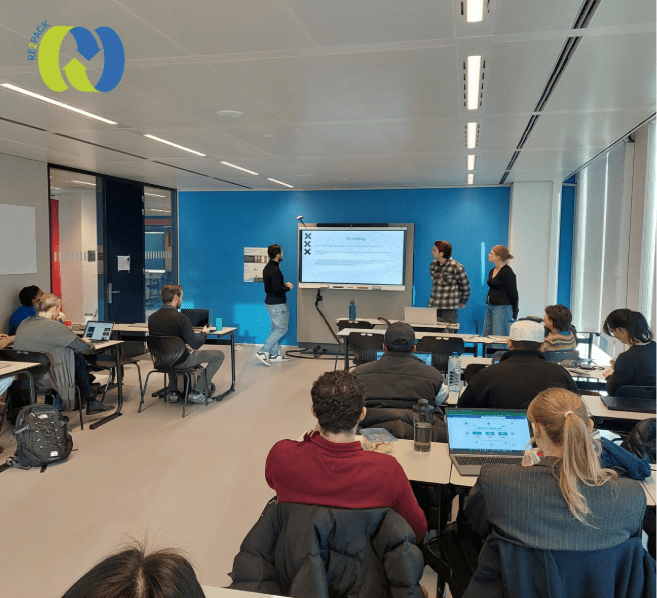
A key conclusion: environmental performance depends on multiple interrelated factors, including distance, return rates, turnover rates and logistics. There is no one-size-fits-all solution, but there is clearly scope for action when partners in the value chain work together.
I am proud of these students because, through their incisive analyses, scenarios and design choices, they have contributed to the transition towards circular packaging systems in cities. Their work also provides valuable input for further research by our PhD students Ignacio G. and Kyenno Scheepers.
Many thanks to all partners and experts for the inspiring discussions; I look forward to continuing the conversation!
 Revolutionary Reusable Packaging